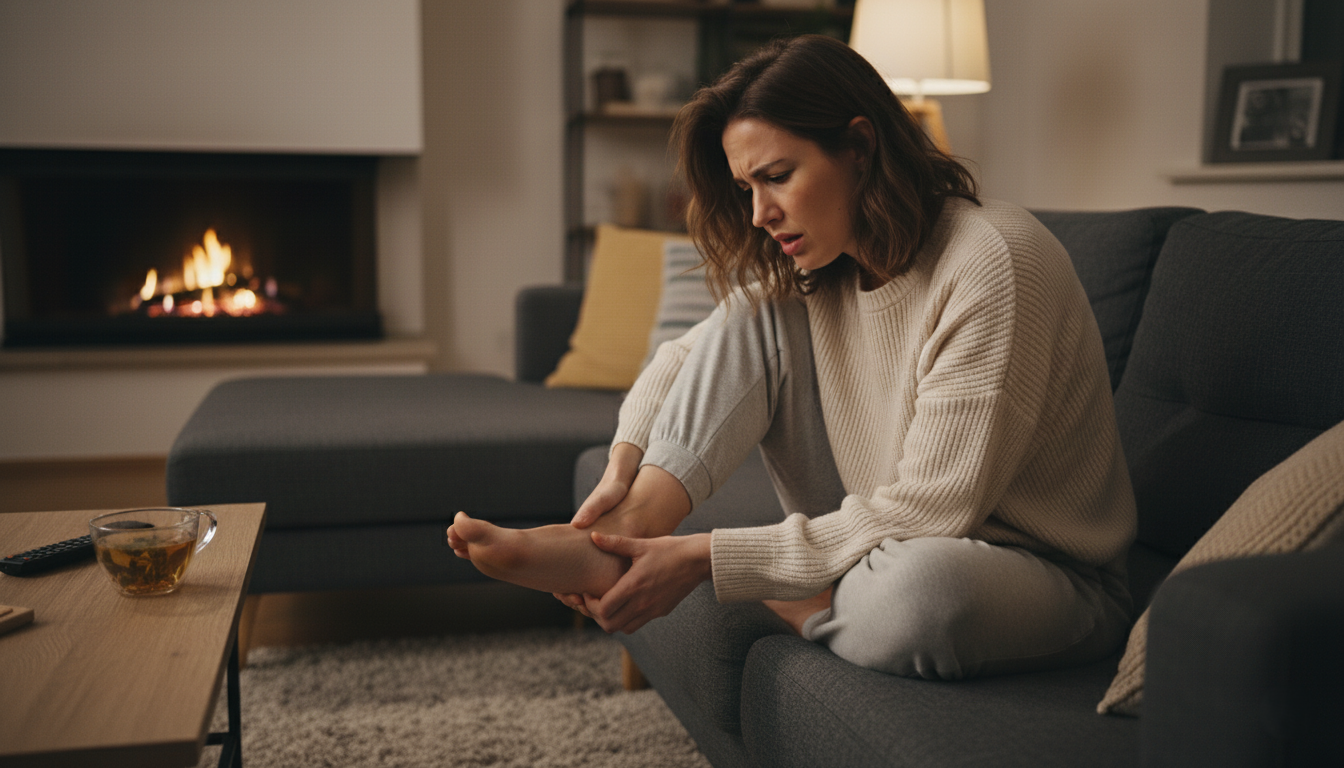
It is a situation that entices anger which many people have in common. You get through your day, keep yourself going, and handle your pain pretty well. Finally, when you sit down to relax, the pain gets even more intense gradually. Your heels may be aching, the arches of your feet may be hurting, or the toes may be feeling stiff and sore. This can be a very confusing and unfair feeling, especially when resting is supposed to be a way of relief.
But the sequence of this pattern is not without reason. From the perspective of foot health, pain that gets worse when you rest has a definite physiological explanation. Knowing the inside of your feet can lead you to take the right practical steps in order to lessen the pain and keep it from getting to the stage of being chronic.
Pain in the feet when at rest is most probably a sign that your feet were long enough without proper support. The body, at the moment you stop moving, changes from compensation to recovery mode, and the pain that you have can be found at that very transition.
Movement Masks Damage, Rest Reveals It
While you move, your muscles stay warm and elastic. Blood circulation is good, and your nervous system prefers movement to pain. This is why you are still able to work even when the tissues are under pressure.
After you sit down, blood flow slows and muscles become relaxed. Inflammation, which has been building up during the exertion, becomes more visible. Structures that are tight or overused are getting stiff, and nerves are more sensitive. That is the reason why the pain can be ascribed to stopping the movement rather than to the movement itself.
This reaction is very typical for people who are standing or walking for many hours and wear shoes that do not provide support
The Role of Inflammation After Activity
Inflammation is the body's natural way of reacting to a tissue strain. During the day, the stresses that are repeated cause tiny damages to ligaments, tendons, and fascia. While the symptoms are kept at a low level by movement, the body takes the opportunity of rest to deal with the damage.
When you sit down, substances that cause inflammation come to the area around the tissue that is under stress. This can cause the parts to throb, become stiff, or feel a burning sensation, which was not noticeable before. The pain is not sudden; it is just that your body finally has the space to register it.
That is why foot pain in the evening is reported by a lot of people and it is even worse than the one in the morning.
Why At-Home Footwear Makes a Difference

The question of what to wear after sports is equally important with that of what to wear during sports. After work, many people put on a pair of soft and unconformable slippers, thinking that just by doing this their feet will recover well and they will be comfortable themselves.
Unfortunately, slippers without a certain structure only allow the foot to go into a tired position more deeply which is the cause of additional stress and pain instead of relief of the already overworked tissue.
The choices of cold weather such as winter slippers for women are often worn for hours in the house, which makes their design very crucial for the process of recovery.
Soft Isn’t Always Supportive
A lot of people think that the word plush means comfortable. Although soft may be in some cases comforting at the beginning, it does not provide the necessary stability for the tired feet.
The too-soft soles collapse when pressure is applied and do not resist the collapse of the arches or the turning out of the heels. Thus the small muscles which stabilize the foot are forced to work even during rest and recovery followingly is delayed.
Most of the fuzzy slippers for women are in this group, as they give more importance to warmth and texture rather than foot alignment.
The Link Between Flat Feet and Post-Rest Pain

The ones who have flat or low arches are more likely to foot pain which worsens after sitting. Their arches do not have the capacity of being natural shock absorbers, that is why the supporting structures have to take more impacts during the day.
After the stop of activities, the overstretched ligaments become tight as they cool down and soreness and stiffness are the result of that. Going back to the standing position may be painful.
Changing into nice slippers for flat feet can provide the support that the arches will need while you are resting and thus the connective tissue will not be strained.
Bunions and Pressure Accumulation
Pain of bunions is one of those pain that become stronger when the foot is relaxed. During the day, shoes may be the means that keep the foot in a certain position and thus the movement of joints is limited.
Once the footwear is taken off, the inflamed joints get a little bit bigger. Without the support, the big toe joint moves into a heavily-used position and thus the pain increases.
Supportive orthopedic slippers for bunions works as a component of stability for forefoot and pressure on the joints is lessened during a break.
Plantar Fasciitis and the Rest Paradox
Plantar fasciitis is a condition that the pain is caused by the situations when one is changing between movement and rest. The plantar fascia is a structure that gets tighter when it is not allowed to move, especially after being on one’s feet for a long time.
When one sits, the tissue gets cold and shortens. On standing, the tissue is stretched in an instant and therefore the pain is very difficult or even impossible to bear.
Wearing women’s slippers for plantar fasciitis can be of great assistance in that case as the fascia will be gently supported even when one is resting, thus it won’t be able to become excessively tight.
Changes in Circulation and Increase in Nerve Sensitivity
Rest affects the way blood circulates. Blood goes to different areas than before when one is sitting, and this is especially true for the lower parts of the body. For certain people, this change puts more pressure on the area around the nerves, and the result is that they feel pain much more intensely than before.
This situation is quite typical for those who have metabolic or vascular diseases and whose blood flow is already not very good.
The right diabetic slippers can help in that they make the feet less prone to pressure points and thus comfortable when such changes in circulation take place.
The Cumulative Effect of Unsupportive Slippers
Pain, which becomes worse when one is at rest, is mostly supported by the everyday habits of a person. That is, if you wear the wrong kind of shoes during the hours you are not working and you do not properly take care of your feet, then your feet will never be able to get a full rest.
Each night becomes a new circle of overstraining instead of relief. This scenario, being temporary, can be transformed into a persistent pain without the passage of a long period of time.
Properly designed orthopedic slippers are aimed at giving the necessary support to the foot during those hours of recovery which are in the night or when you are resting.
Why Recovery Requires Alignment, Not Just Rest
Recovery in its real sense is when the stressed tissue gets to heal and the healing takes place in the right alignment. Just giving the feet a rest from the weight is not enough if the foot folds down into a harmful position while resting.
Supportive shoes keep the feet in the right position even when the activity is very limited. This lessens the strain on the tissue which is in the process of healing and gives it more opportunity to recover from inflammation.
Regardless of whether you are sitting, standing for a short while, or walking around the house, this rule still stands.
Recognizing the Warning Signs
The pain that becomes more severe when one sits down is indicative of the fact that the feet are overloaded. It usually means that there is inflammation, poor support, or both.
Not paying attention to this signal results in damage accumulating. The time will come when what had started as evening discomfort will progress into morning pain and then constant soreness.
A better at-home support and early intervention is the way to stop the progression from going further.
Creating a Supportive Evening Routine
The state of one’s feet is not dependent on the time when you leave work or take off your shoes. What you do in the evening has a very important part in the process of recovery.
Supportive slippers, calm movement, and not standing barefoot for a long time on a hard floor are all ways in which you can help put an end to the post-activity pain.
Why Comfort Should Still Have Structure
Comfort is frequently perceived as just being soft. In reality, comfort also comprises stability, alignment, and pressure redistribution.
Supportive footwear with a comfortable heel, a footbed that follows the arch of the foot, and a toe-box that allows natural toe spreading will help the foot to rest and recover, not to weaken again.
Such comfort makes a difference to the "feel" of a foot—it might be very subtle at the beginning but later it reveals its advantages.
Listening to Rest-Time Pain

If the pain in your feet increases when you sit down, then this is a sign from your body which shouldn't be ignored. Your body tells you that your feet are under-supported and overused.
Don't cast this pain into the category of something you don't understand and can't avoid, but rather acknowledge it as a pattern that has a solution. Supporting your feet not only during activity but also at rest is giving them the way to heal themselves.
Relief from the pain of doing less is not what is coming—it is coming from better support. When recovery is a matter of choice, rest will be really rest again.