Clogs should feel easy to wear, but that does not mean the fit should be careless. A pair that is too tight may press against your toes or instep, while an oversized pair can slide around and make you grip with your toes while walking.
So, how should clogs fit? Your toes should have room to rest naturally, your foot should remain centered on the footbed, and the upper should feel secure without pinching. With backless clogs, a small amount of controlled heel movement can be normal. Your heel should not, however, slide from side to side or feel as though it will leave the shoe with every step.
This clog sizing guide covers heel slip, toe room, width, instep fit and how to choose the correct women's clog size. You can also browse the complete Aerothotic women's clogs collection while comparing fit features and styles.
How Should Clogs Fit Overall?
A properly fitting pair of clogs should meet five basic conditions:
- Your toes can lie flat without touching the front.
- The widest part of your foot sits fully on the footbed.
- The upper feels secure across the instep without creating pressure.
- Your heel remains centered instead of slipping sideways.
- You can walk naturally without curling or gripping with your toes.

The contoured footbed, heel cup and adjustable upper all influence how a clog fits.
Unlike lace-up shoes, backless clogs do not lock the heel completely in place. The goal is controlled movement, not a restrictive fit and not a loose, unstable one.
Why Do Clogs Fit Differently?
Clogs are built differently from closed shoes. Most have a covered toe and an open heel, leaving the upper and footbed responsible for controlling the foot.
They may also feel different from women's slide sandals. Slides usually have an open toe, making it easy to see whether the foot is positioned correctly. With clogs, you must pay closer attention to how your toes feel inside the covered front.
A correct clog fit should feel relaxed while still allowing you to walk normally. You should not need to tighten your toes, shuffle your feet or shorten your stride to keep the shoes in place.
Clog Heel Slip: How Much Is Normal?
A small amount of clog heel slip can be normal in a backless design. As you take a step, your heel may rise slightly before settling back onto the footbed.
Normal heel movement should feel smooth and controlled. The clog should follow your stride without forcing you to grip the footbed with your toes.
Heel slip may be excessive if:
- The clog nearly comes off with every step.
- Your heel repeatedly lands on the edge of the footbed.
- Your foot slides forward until your toes touch the front.
- You have to shorten your stride to keep the clogs on.
- Your toes curl to prevent the shoes from slipping.

The open-back construction can allow a small heel rise, but the foot should remain centered.
If your clogs have an adjustable buckle, check the instep fit before changing sizes. A small strap adjustment may improve stability. If the upper is already adjusted and the clog still feels uncontrolled, the size may be too large.
How Much Toe Room Should Clogs Have?
Proper toe room in clogs lets your toes rest flat and move naturally. Your longest toe should not press against the covered front, and your smaller toes should not feel compressed.
Too much empty space can also cause problems. If a clog is excessively long, your foot may slide forward and repeatedly strike the toe area.
While standing, check that:
- Your toes do not touch the front.
- You can gently move your toes.
- The toe box does not press against your toenails.
- Your toes remain relaxed while walking.
- Your foot does not slide forward on slopes or turns.

Check the covered toe shape and footbed length before selecting your size.
Always evaluate toe room while standing. Your feet spread under body weight, so clogs that seem spacious while seated may feel different once you begin walking.
Check the Width and Instep Fit
Length is only one part of clog sizing. Your foot should sit completely within the edges of the footbed. If the sides of your feet extend over the footbed, the clog may be too narrow even if the length looks correct.
The instep is equally important because the upper helps control your foot. It should feel gently secure without creating pinching, rubbing or deep pressure marks.

An adjustable buckle lets you fine-tune the instep without affecting toe room.
If the clog has an adjustable buckle, begin with a slightly relaxed setting. Walk several steps and tighten it gradually until the shoe feels stable. Do not overtighten the buckle to compensate for a clog that is too long or wide.
Check the Footbed and Arch Placement
A supportive footbed only works as intended when your foot is correctly positioned on it. The raised contour should meet your natural arch rather than feeling too far forward or too close to your heel.
Your heel should also rest in the center of the heel cup. If the heel sits on the back edge or repeatedly shifts to one side, reconsider the size.

The raised arch contour should sit under your natural arch, not ahead of or behind it.
Women who want to compare other contoured footwear options can explore Aerothotic's arch support collection.
Women's Clog Sizing: A Step-by-Step Guide
Women's clog sizing can vary according to the design, foot shape and socks you plan to wear. Follow these steps before ordering:
1. Measure Both Feet
Measure from the back of your heel to the end of your longest toe. Because one foot may be slightly larger, compare your size using the measurement from the larger foot.
2. Measure Later in the Day
Feet may become slightly fuller after several hours of standing and walking. Measuring later in the day provides a more realistic indication of how the clogs may fit during regular wear.
3. Consider Your Socks
If you plan to wear your clogs with fall or winter socks, measure and try them on with a similar pair. Thick socks can affect toe space, width and instep pressure.
4. Start With Your Usual Sandal Size
Your regular sandal size is usually the best starting point. Do not automatically size down simply because the clog has an open back.
5. Check the Official Size Chart
Compare your measurement with the Aerothotic Clogs Size Chart. If you fall between sizes, consider your foot width and whether you plan to wear socks.

Compare your foot measurement against the chart before choosing a size.
6. Walk in Both Clogs Indoors
Test the clogs on a clean indoor surface. Walk normally, turn in both directions and take several longer steps. Pay attention to heel movement, toe position and whether the foot slides sideways.
How Should Atlas LC1424 Clogs Fit?
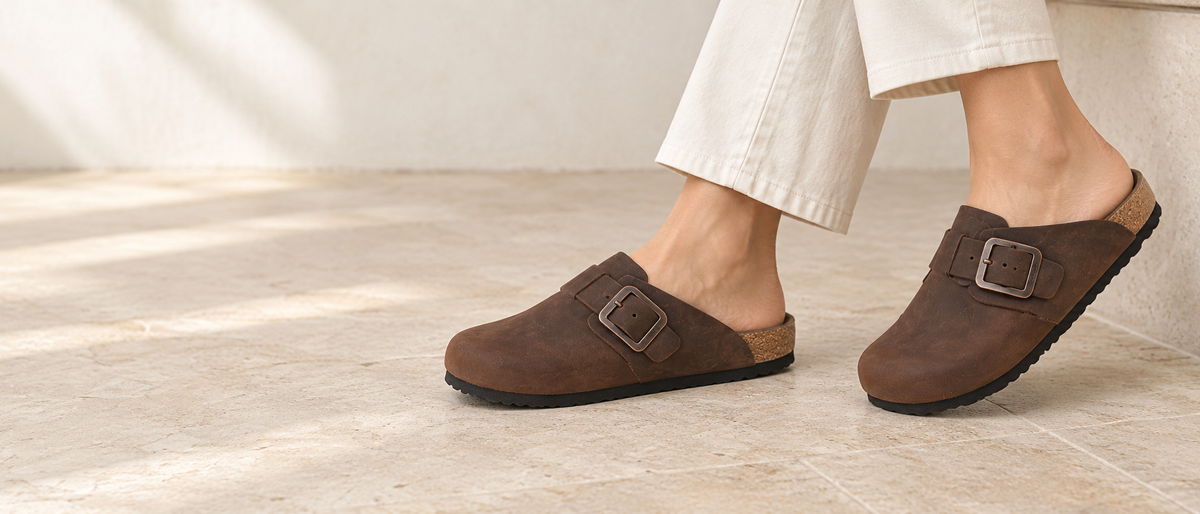
The Atlas LC1424 clogs should feel supportive underfoot while allowing your toes to rest naturally. Your heel should remain centered on the cork footbed, with only a modest rise during each step.
Atlas includes an adjustable buckle that helps refine the fit across the instep. Adjust it until the upper holds your foot without pinching. Your foot should not slide forward when you walk.

The adjustable buckle helps create a more secure fit across the instep.
Begin with your usual sandal size. If you normally wear a half size or have wider feet, consider moving up to the next available size. Atlas is designed around a medium-width fit, so women needing more width should pay close attention to the edges of the footbed and the pressure across the instep.
If you like the structured feel of cork but want to compare different silhouettes, browse Aerothotic's cork footbed sandals.
Are Clogs Supposed to Be Loose?
Clogs are supposed to feel relaxed, but they should not feel uncontrolled. A small amount of heel lift is different from the entire foot sliding inside the shoe.
A good fit keeps the ball of the foot and heel aligned with the footbed. The upper should provide enough control that you can walk without consciously trying to keep the clog attached to your foot.
Signs Your Clogs Are Too Small
Your clogs may be too small if:
- Your toes touch the covered front.
- Your heel rests on or beyond the back edge.
- The sides of your feet extend over the footbed.
- The upper pinches your instep.
- Your toes feel crowded when standing.
Do not depend on extended wear to correct a length or width problem. A footbed may gradually feel more familiar, but an incorrectly sized clog will not become longer.
Signs Your Clogs Are Too Large
Your clogs may be too large if:
- Your foot slides forward and backward.
- Heel lift becomes exaggerated.
- The upper cannot hold your foot securely.
- You curl your toes to prevent slipping.
- Your heel repeatedly lands away from the center.

A correctly sized clog keeps the foot centered with no forward slide or exaggerated heel lift.
Before exchanging the size, adjust the buckle and retest the clogs with your intended socks. If the sliding continues, a smaller size or a different shape may be more appropriate.
Can You Wear Clogs With Socks?
Yes. Clogs can be worn barefoot or with socks, depending on the season and design. Choose your size based on how you expect to wear them most frequently.
When trying clogs with thicker socks, make sure your toes can still move and the upper does not become tight across the instep. For softer indoor options, compare Aerothotic's women's slippers collection.
For seasonal styling advice, read why clogs make sense for transitional fall weather.
More Aerothotic Clog and Footwear Guides
Continue planning your seasonal footwear rotation with these related guides:
- Best Transitional Shoes for September and October
- Transitioning Your Favorite Clogs From Fall to Winter
- Why Arch Support in Sandals Matters More Than You Think
Find Your Best Clog Fit
When asking how should clogs fit, remember the difference between relaxed and oversized. The right pair provides natural toe room, keeps your foot centered and allows only controlled heel movement.
Start with your usual sandal size, account for your foot width and intended socks, and walk in both clogs before deciding. Compare the available styles in the Aerothotic women's clogs collection to find the pair that best matches your feet, wardrobe and daily routine.
Frequently Asked Questions
Is heel slip normal in clogs?
Yes, a small amount of heel lift is normal in a backless clog. It becomes a problem only if the heel repeatedly lands off the footbed or you have to shorten your stride to keep the clog on.
Should I size up or down for clogs?
Start with your usual sandal size. If you wear a half size or have wider feet, size up to the next full size rather than sizing down.
How do I know if my clogs are too wide or too narrow?
Your foot should sit fully within the edges of the footbed. If the sides of your feet hang over the edge, the clog is too narrow. If your foot shifts side to side on the footbed, it may be too wide.
Can clogs be worn with socks?
Yes. If you plan to wear socks regularly, try the clogs on with a similar pair before deciding on a size, since thicker socks affect toe space and instep pressure.
My clogs still feel loose after adjusting the buckle. What should I do?
If the buckle is already adjusted and the foot still slides forward or the heel lift feels exaggerated, the clog is likely too large and a smaller size is worth trying.